
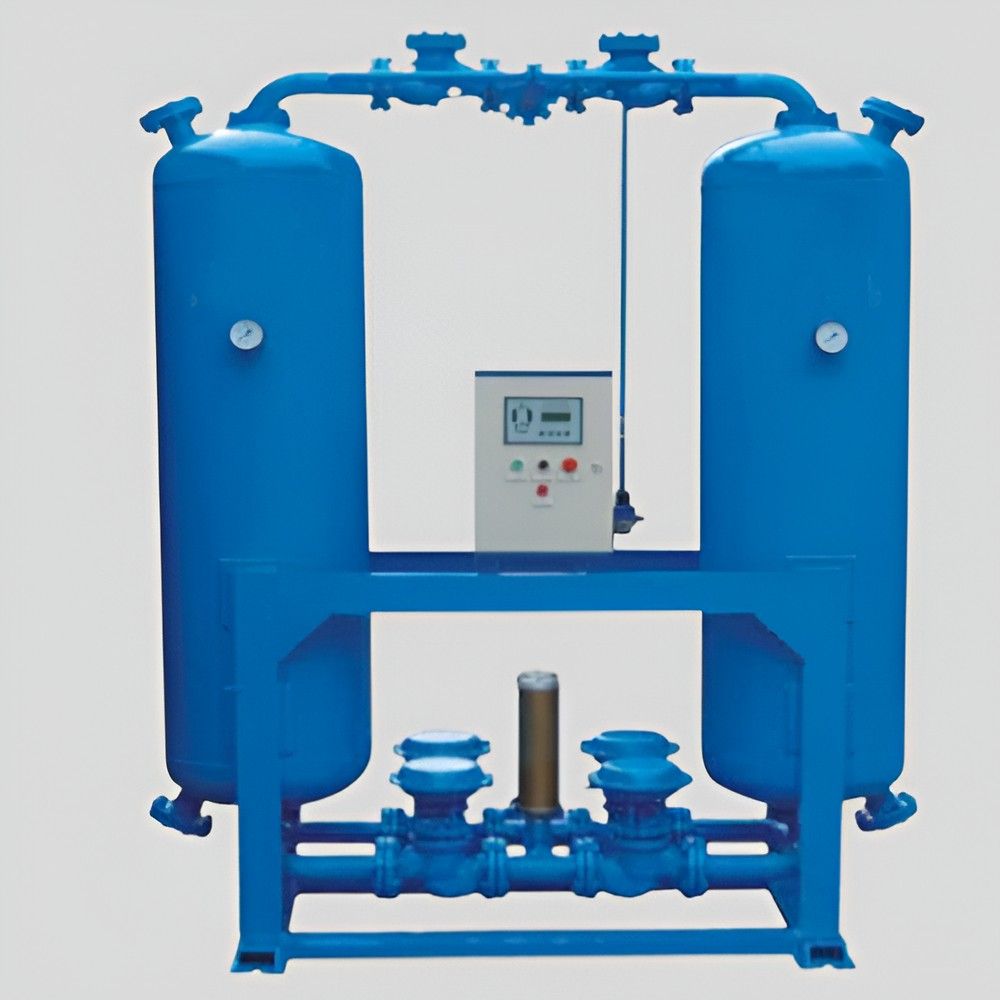
The JOG WASTE heatless dryer can produce arid compressed air by utilizing desiccant’s innate propensity to achieve equilibrium with their environment.
These dryers consistently deliver a sensible temperature and dew point at the outlet. These most affordable dryers can readily attain dew points as low as (-) 40 degrees Celsius. These dryers are often chosen for flows up to 500 CFM. There is No heater, internal or external, is used. Up to 18% of the airflow can be used for purging. At 7 Kg/cm2(g), the pressure dew point in this sort of drier is -40°C, and it is possible to attain pressure dew points as low as -70°C.
Two adsorber towers in the heatless air dryer are loaded with activated alumina or molecular sieves to soak up the moisture in the moist compressed air. To produce a higher dew point, moist entering compressed air or gas is fed through an adsorber tower. The tower’s summit is where the dry air enters. Activated alumina requires renewal after some time in operation. For the activated alumina to regain its absorptive capacity and expel the moisture that has been absorbed, it must be reactivated or regenerated. Purging the adsorbent with dry air or gas in the opposite direction at atmospheric pressure and temperature does this. There is a 10% dry air loss during the purge. A PLC/timer will control the switchover, and the outlet will get continuous dry air.
By incorporating an online dew point transmitter with the sequential programmer, PURGELOSS of 10% is decreased to 5%. As the dew point drops to the correct level, the drying tower switches over, greatly reducing the need to purge air.
A non-lubricated switching valve directs wet compressed air into the drying tower from the bottom oil and pre-removing filters. Dry desiccant comes into contact with air, which transfers moisture from the air to the desiccant. When drying, air flows upward; the towers’ shape prevents the desiccant from becoming fluidized. Via check valves at the top of the dryer, the dry, processed air is routed to the dryer’s after filter. In the regenerating tower, where it is depressurized to atmospheric pressure and utilized to regenerate the desiccant, around 10% of the dry air is sent. The purge air is forced out to the atmosphere once the desiccant has dried off its moisture. It leaves the dryers through a muffler. The dryer shifts towers at a predetermined time determined by the computerized controller. At tower shift, the switching valve shifts consecutively, the off-stream tower is depressurized, and the regenerating tower is gradually repressurized. Solenoid valves manage the switching and exhaust valves.
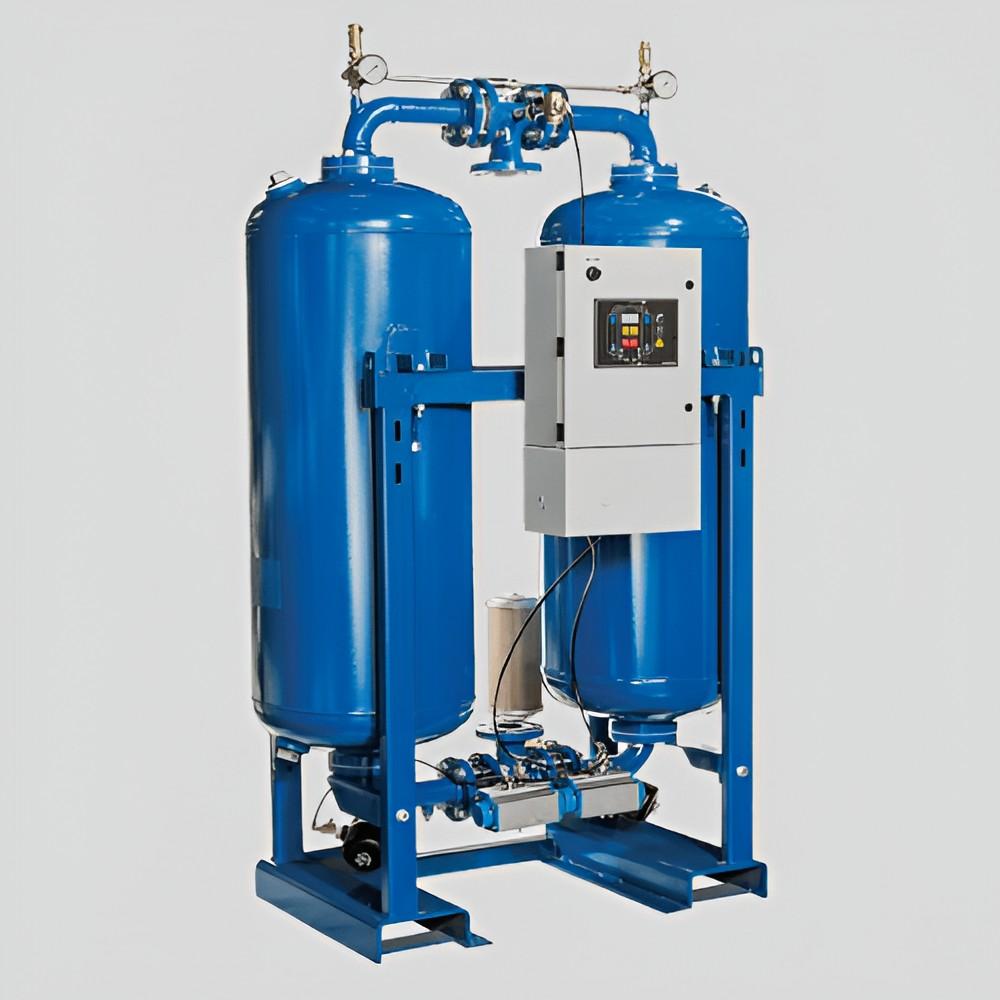
With the most cutting-edge technology and dependability, JOG manufactures the most dependable Heatless Desiccant Air Dryers, ensuring trouble-free functioning for a very long time.
By utilizing “Pressure Swing Adsorption Technology,” Heatless Compressed Air Dryers may reduce moisture in compressed air to a level of 10 ppm (w). A controller for energy management to reduce purge loss Class 3 and 2 air quality according to ISO 8573 – 1, 7.2, Table 3, large desiccant beds for steady dew point
There is a lot of water vapor in the compressed air that comes out of the compressor. If the distribution lines receive untreated air, the moisture would cool and condense to liquid water. In compressed air systems, condensed water is a significant source of downtime.
When employed in today’s advanced air systems, air that was once suitable for wide-tolerant air tools or antiquated hand-operated valves is just insufficiently dry. Water results in component failure and product rejection because it causes rust, pitting, clogs, and freeze-ups. Lowering the air’s dew point is the only way to stop water from condensing in related pipelines. Owning and running an air dryer is less expensive than having to deal with the issues it can solve. It saves money to dry compressed air instead of costing money.