
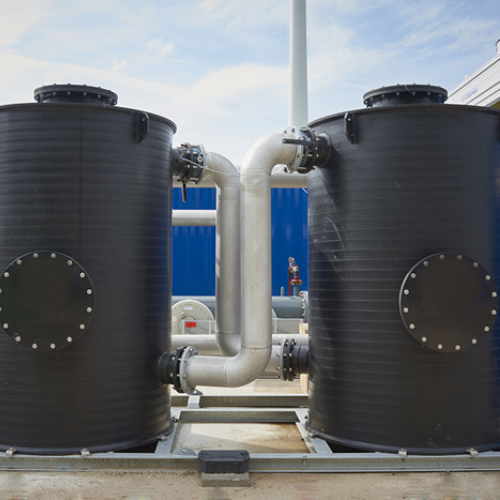
We Jog Waste are the leaders in the H2S removal in the biogas system. Our innovative approval and extensive experience have positioned us as the preferred partner for biogas desulfurization projects. If you are looking for effective and reliable solutions with the best cost-effectiveness in the industry to enhance the quality of your biogas, you have come to the right place.
It is crucial to remove H2S from biogas for safety reasons, equipment protection, and biogas quality. H2S is toxic, corrosive, and poses risks to health and the environment. By removing it, a safe environment is created, corrosion is prevented, and the purity of biogas is improved, increasing its commercial value and potential as a renewable energy source. With our specialized H2S removal solutions at JOG Waste, we guarantee efficient and safe desulfurization, meeting the highest quality standards.
We Jog Waste understand the challenges associated with H2S in biogas and offer customized solutions to meet each client’s specific needs. Our team of highly trained experts uses advanced desulfurization technologies to ensure efficient H2S removal and minimize environmental impacts through our line of iron-hydroxide-based products.
After thoroughly mixing the iron scraps and wet sawdust, 0.5% calcium oxide is added to desulfurize the mixture. 30%–40% humidity is present. By reacting with the desulfurized ferric hydroxide, the hydrogen sulfide is eliminated, and the regenerated ferric hydroxide can then be continually used.
First, H2S and oxygen combine to generate SO2. The created SO2 continues to react with H2S in the combustion furnace, allowing for the direct production of high-quality molten sulfur from the gas phase.
Hydrogen sulfide is absorbed by activated carbon, and then it is broken down into monomer sulfur and water by oxygen. The activated carbon can be utilized constantly once the sulfur has been removed using amine sulfide. Tar that contains gas cannot be processed using this approach.
Hydrogen sulphide and the granular zinc oxide react to form zinc sulphate and water. This technique is mostly used to clean up waste gases with less hydrogen sulphide in them. Although the cost is very high, this technology has a high efficiency in the H2S removal system.
The removal, recycling, and safe treatment of H2S-containing waste gases produced by industrial processes is mostly accomplished via techniques like absorption, adsorption, and catalytic oxidation. There are two different types of desulfurization methods among them: dry method and wet method.
Sulfur recovery should be the basis for natural gas and refinery gas with a high percentage of H2S and a significant total amount emitted from petroleum, chemical, and other industries. use the Claus method and the absorption oxidation method primarily.
Chemical absorption or absorption oxidation are two purification methods that can be employed for low-concentration H2S gas.
H2S removal system using the dry method
The Claus technique, the ferric hydroxide method, the activated carbon method, and the zinc oxide method are the primary ways for removing H2S via the dry method.
Biogas is typically used in gas engines for combined heat and power production (CHP) or in boilers for steam or power production. During combustion, the H2S will convert to H2SO4 (sulfuric acid). This acid is extremely corrosive and will destroy the engine or boiler in a very short time. Therefore, it is necessary to remove the H2S before combustion. The H2S is typically present in Raw biogas minimum of 2000 to 3000 ppm and this also depends on the feedstock used to be fed as raw material for Biogas generation. Hydrogen sulfide (H2S) Hydrogen sulfide is a colorless, extremely deadly gas that has an odor similar to rotten eggs when it is at ambient temperature. It burns with a blue flame and is combustible.
There are different methods available to treat H2S gas such as Biological, Chemical, Solid absorption, etc.
We Jog Waste provides activated carbon and NaOH scrubbing method to treat H2S generated from an Anaerobic digester, this method is suitable for 2000 to 10000 ppm of H2S of stream gas.
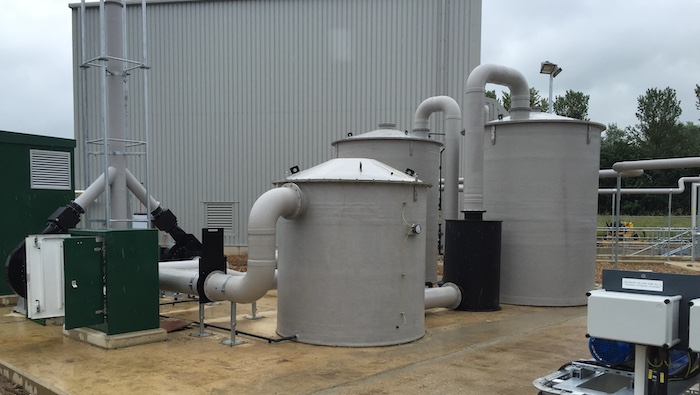
The equipment system for H2S removal can be of PP, SS, and FRP made as per the requirement of customer and commercial viability.
Our JOG Waste activated carbon and NaOH effectively removes H2S and:
The corrosion will literally reduce the lifetime of the downstream equipment’s by years! This is why biogas engine manufactures require that H2S in the clean biogas not exceed 50 -100 ppm. Otherwise, the operating costs for change of engine oils, spark plugs and other maintenance will increase significantly. Furthermore, there will be high cost for repairs and income lost during overhouls and break downs.
Air quality standards are another driver for H2S removal. Combustion of un-cleaned biogas will result in sulfur dioxide (SO2) emissions, which causes serious odor problems as well as acid rain. Also health the safety standards require H2S removal and H2S it toxic even in small concentrations.
In Upgradation/purification projects, the biogas is converted to biomethane or Renewable Natural Gas (RNG) by separating the CO2 from CH4. When the biogas is upgraded with VPSA technology, the H2S will follow the CO2 stream. Before releasing the CO2 into the atmosphere the H2S has to be removed typically to below 5 ppm or Nil.
The Biogas produced contains approximately 55% to 60% methane, 40% to 45% carbon dioxide, and trace amounts of hydrogen sulfide. Biogas is purified to remove carbon dioxide and hydrogen sulfide gases to prepare CBG. The CBG can be transported through cylinder cascades or pipelines to retail outlets.
Wet approach Solvent method, neutralization method, and oxidation method are the three main methods used to remove H2S.
This procedure typically uses an aqueous solution of 15%–20% diethanolamine to absorb hydrogen sulfide and create a “complex” out of it. Hydrogen sulfide precipitates at temperatures between 100 and 130 °C, and high-concentration hydrogen sulfide can be created via condensation, which is subsequently converted to sulfur.
An alkaline absorbent can be used to extract hydrogen sulfide, which is an acidic chemical. Ammonia water and sodium carbonate solution are two commonly utilized absorption solutions.
Hydrogen sulfide is converted to sulfur under the influence of a catalyst after being absorbed by lye. The catalyst can be used once more after being air-regenerated. Nickel salt, ferricyanide, iron oxide, iron hydroxide, alkali metal salts of sulfide, arsenic acid, etc. are examples of catalysts that are frequently used